


The FAA issued 12,961 original flight instructor certificates in 2025. That’s 67 percent more than in 2021, and the number climbed every year in between. That means a decently large number of CFIs teaching new pilots earned their certificate within the last two or three years.
Many of these instructors are incredibly sharp and motivated, and they’re more current on the regulations than the rest of us have been since our last knowledge test. What they don’t have yet is repetition at the actual job: watching a learner, figuring out what’s wrong, saying the right thing at the right moment, and then being quiet. That skill develops faster in a flight simulator than anywhere else.
Workload Reduction
In the airplane, the instructor is both pilot in command and teacher, and the first job always comes first. A new CFI watching a learner fly a gusty crosswind approach may be mostly watching the runway, airspeed, and distance between the upwind wing and the ground.
It follows that new instructors tend to teach by correction. When the learner drifts left, the instructor says “correct right.” Fast or slow on final gets “airspeed.” The learner fixes the symptom, but doesn’t necessarily find out why it happened in the first place, or at least not promptly.
In a flight simulator, the safety job goes away. Nothing bad happens if the learner balloons the flare, so the instructor can attend to the learner instead of the airplane: where her eyes go on short final, whether her hand drifts off the throttle, and the moment she stops making radio calls because she’s out of attention. Those observations show the instructor what’s causing the error. Without them, the learner and instructor can end up correcting the same symptom lesson after lesson.
Once an instructor has seen a cause enough times in the sim, she starts seeing it in the airplane too, usually a few seconds before the symptom shows up.
Learning When To Stay Quiet
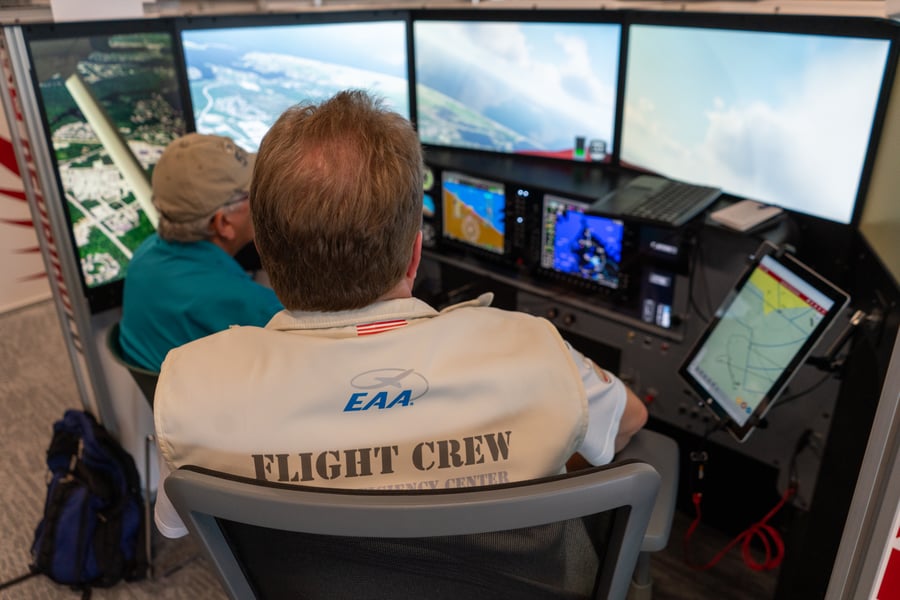
Silence may be the hardest instructor skill to learn, as is avoiding intervention by taking the controls. In an airplane, uncorrected errors cost altitude, airspeed, and/or position. What that means to the learner is time and money. Letting a learner make a mistake might feel like negligence to fresher instructors, so the instructor steps in early, and the learner never gets the chance to recognize and fix her own error.
The sim, however, lets an instructor practice the restraint that airplanes and physics sometimes punish. Let the learner fly through the localizer, or forget to switch tanks. Watch how long it takes her to notice, and say nothing until she does or until the lesson starts to fall apart. Then pause the sim, or don’t, and talk about it.
After a few of these moments, an instructor has a reliable sense of how far a learner can go before she needs help, and she takes that sense into the airplane. The margins there are smaller, of course, but her judgment about when to speak has been exercised somewhere it was allowed to be wrong, and therefore much more instructive.
Explaining Without Demonstrating
The next time you brief a holding entry, see if you can explain it without using your hands. Sure, this sounds a little strange, but at least be mindful of how much you use your hands to describe an entry to a hold.
Most of us can’t do this without some thought and practice. In the airplane, we point at instruments and take the controls to demonstrate. Those shortcuts work in the moment, but they cover up explanations that don’t hold up on their own. The learner nods, the instructor moves on, and the gap shows up three lessons later during an approach briefing.
The sim exposes weak explanations quickly, because the instructor has every reason and ability to stop and explain properly. Freeze the simulation at the point of confusion, and the instructor has as long as they need to get the explanation right. Instructors who teach in the sim regularly develop tighter, clearer explanations, and they use them in the airplane too.
Debriefing With Evidence
Airplane debriefs run on memory, and the instructor and learner do not always remember the flight the same way.
The Redbird instructor station displays Vertical Track and Glidepath charts on its map, and the instructor can save a flight or reposition the aircraft to fly any segment again. That lets the debrief address directly what the airplane actually did. A new instructor who debriefs this way for a few months learns what a good debrief sounds like: short, specific, and limited to the one or two items that made the biggest difference, both negative and positive. They keep debriefing that way on the ramp after airplane lessons, with no charts to point to.
The Bottom Line
If you run a school, make simulator teaching part of how new instructors start.
Assign new lessons where teaching skill is most readily demonstrated, such as early instrument scan work and emergency procedures, with a senior instructor in the room observing, or review afterward. Redbird Connect, a feature in the instructor station, enables CFIs to run or observe a session remotely on Redbird simulators running the Navigator operating system, with the panel and a live video feed on screen. A chief instructor can watch three new CFIs teach in an afternoon without climbing into three airplanes.