
%20(3).png?width=40&height=40&name=Redbird%20Flight%20logo%20(red%20bg)%20(3).png)
Flight school owners spend a lot of time thinking about aircraft. Not because they enjoy it, but because they have to. Acquisition costs, insurance, financing, maintenance reserves, dispatch reliability, and utilization often sit on a knife’s edge. A small shift in any one of those variables can reshuffle the accounting books.
Flight simulators, by contrast, are often discussed in a different category. They are treated as instructional tools rather than fleet assets. This framing is understandable, but it can obscure an operational reality that becomes clear once the numbers are examined closely.
When a flight simulator is evaluated with the same discipline applied to an aircraft, it often turns out to be the most cost-effective flight training asset on the field — for a number of reasons.
1. Predictable Operating Costs
Aircraft economics are familiar because owners have learned to itemize them carefully. The purchase price is only the starting point. Financing often follows. Insurance premiums rise with utilization. Annuals and 100-hour maintenance are predictable, but unscheduled maintenance is not, nor is it optional. Engines move steadily toward overhaul; avionics depreciate regardless of use; and a single inoperative component can ground the entire asset. Add weather exposure, and the financial profile of a training aircraft becomes clear: It is essential but inherently volatile.
A flight simulator is different. Its acquisition cost is fixed. Software and support expenses are known in advance. Mechanical wear is minimal. There is no engine reserve accumulating hour by hour, no propeller overhaul on the horizon, and no weather system capable of shutting it down. The cost curve is flatter; the variance is lower; and unpleasant surprises are rare.
That distinction matters more than absolute price. Most owners do not struggle because assets are expensive; they struggle because costs are unpredictable. Flight simulators reduce that unpredictability in a way few other training assets can.
2. High Utilization Potential
In aviation training, utilization is the economic lever that matters most. A fixed-cost asset that operates 30 hours per month has a different impact on all aspects of a school’s operations than one that operates 90. Aircraft owners understand this instinctively, which is why dispatch efficiency, instructor availability, and weather forecasting receive constant attention.
Flight simulators have inherent advantages aircraft simply do not.
-
They can be scheduled early or late without concern for noise or lighting.
-
They are unaffected by weather.
-
Lessons do not end abruptly because of a hard landing or an unexpected diversion. When a student makes a mistake that would terminate a flight, the session continues. Reset, reposition, and keep going.
As a result, flight simulators can achieve utilization rates that would be unrealistic—or unsustainable—for aircraft. But the more important point is not raw utilization. It is how that utilization is achieved.
One of the most common misconceptions about simulator economics is that increased simulator use must come at the expense of aircraft hours. In practice, that is not necessarily the case in many well-run schools. The reason comes down to a simple diagnostic question: What is actually limiting student throughput?
In many training operations, the limiting factor is not aircraft availability but instructor availability. Airplanes sit idle not because student demand is absent, but because instructors are already fully booked. Operators who are unsure which constraint applies to their operation can run a simple check: If adding one more airplane tomorrow would not increase weekly student completions, the bottleneck is almost certainly instructor time, not hardware.
This is where modern simulator-based training workflows, and some helpful training software, change the equation.
When simulators are used only as substitutes for actual aircraft, they inevitably feel like competitors to the aircraft fleet. When they are used to expand training capacity, they become complements.
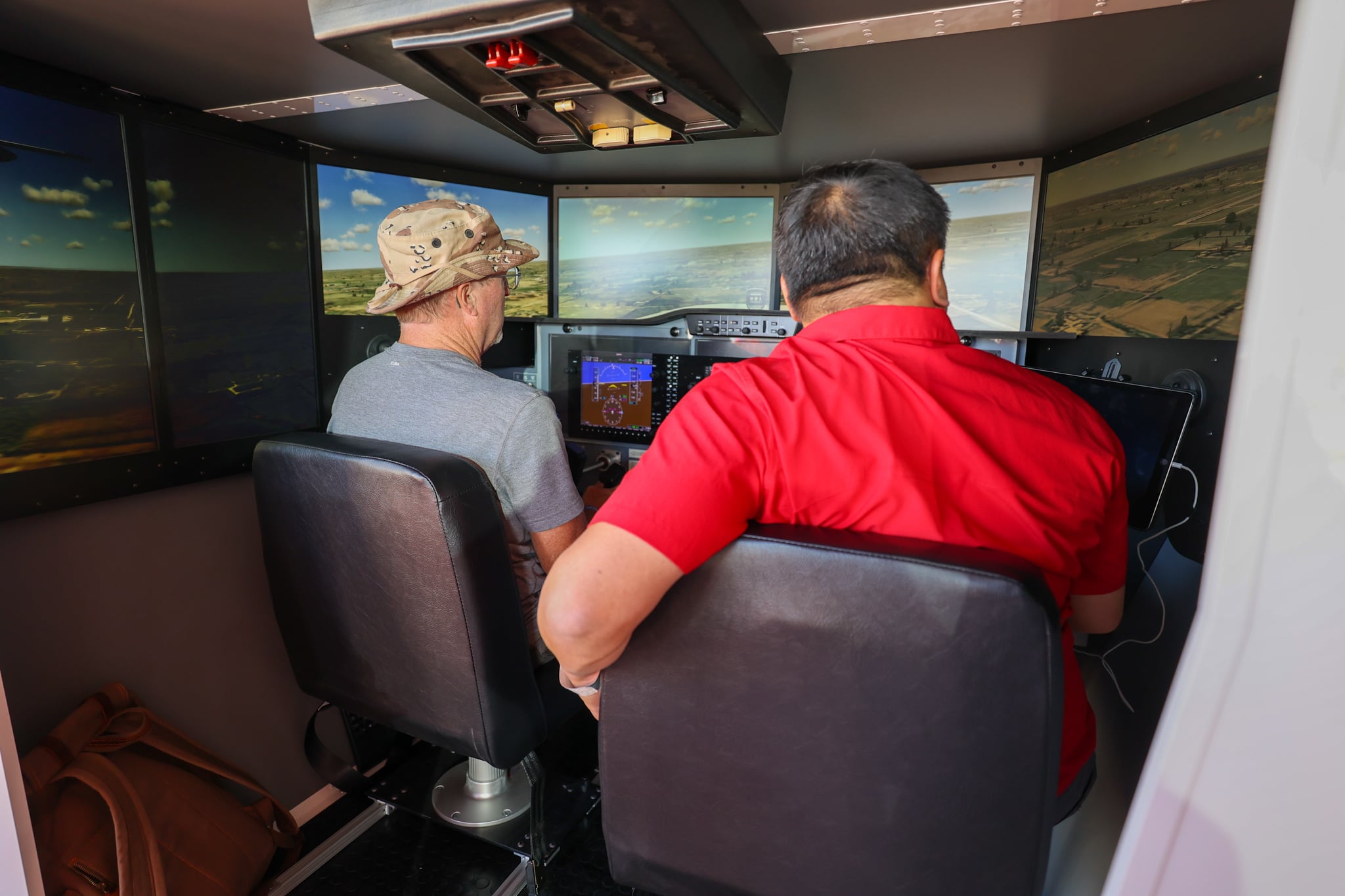
Training products such as Guided Independent Flight Training (GIFT) make this distinction clear. With GIFT, students can use the simulator to learn, practice, and receive objective performance feedback without requiring a CFI to be physically present. Meanwhile, staff CFIs remain scheduled in aircraft, flying with other students and logging hours.
The result is not fewer aircraft hours. It is more students progressing at the same time.
.jpg)
Students who would otherwise be waiting for instructor availability continue moving forward. Aircraft utilization remains strong. Instructor schedules stay full.
From an operational standpoint, the simulator stops competing with the fleet and starts increasing the total amount of training the school can deliver each week. It absorbs training tasks that do not require an instructor’s presence, relieving pressure on the system rather than redistributing it.
3. High Margin Potential
A flight simulator session generates revenue, yet the variable costs are dramatically lower compared to sessions in aircraft. Instructor pay may be identical, but the simulator hour does not advance an engine toward overhaul or push an airframe closer to inspection. There is no fuel bill, save for a few cents of electricity.
Over time, the difference becomes difficult to ignore. Every additional aircraft hour carries a hidden future cost. Every additional simulator hour carries far fewer embedded future costs.
This does not mean flight simulators are more valuable than aircraft. It means they are efficient in a way aircraft cannot be.
A Framework for Evaluation
To ground the conversation, let's consider an example. This example should not be considered a forecast. It is a way of structuring the variables so that each operator can substitute their own numbers.
The inputs used here are reasonable and conservative, but your acquisition cost, pricing strategy, and utilization may differ. The goal is not to predict your return but rather to show which variables drive it.
Assume an installed cost of $100,000 for a full-motion Advanced Aviation Training Device (AATD). This is a reasonable ballpark for evaluating economics.
Simulator hourly pricing is set by the owner, but in practice it often lands at roughly half the rental rate of a comparable training aircraft. For many schools, that places simulator time around $90 per hour—high enough to signal value but low enough to remain accessible.
Now assume 15 hours per week of simulator utilization. That averages just over two hours per day and is well within reach for a simulator that is scheduled intentionally and used to expand capacity rather than replace flights. At that rate, the simulator produces 780 hours per year. At $90 per hour, annual revenue comes to approximately $70,200.
The distinction between simulators and aircraft becomes even more apparent on the expense side. Electricity, using a national average of approximately $0.17 per kilowatt-hour, amounts to only a few cents per operating hour. Over an entire year, it remains a rounding error rather than a driver. Facility costs are similarly modest, particularly when simulators occupy existing space.
Excluding instructor pay, first-year direct operating costs are minimal. The most significant ongoing expense, service and support, does not appear in the first year for many new devices under warranty. With that assumption in place, first-year operating costs (excluding instructor pay, which is typically comparable to aircraft instruction) could be as low as $160 in this scenario.
In the second year, when a service agreement becomes active, operating cost rises to approximately $6,400 annually, assuming an $8 per-hour service rate for a full-motion device. That increase is real, predictable, and scales directly with use.
With those assumptions in place, the economics are straightforward. In the first year, revenue of $70,200 minus approximately $160 in direct operating costs yields roughly $70,000 in contribution. In the second year and beyond, that contribution settles at approximately $63,800 per year under identical utilization.
This example excludes financing, taxes, and broader overhead — costs that vary too widely by operator, tax situation, and existing infrastructure to generalize usefully. However, it illustrates the simulator's variable cost structure, which is arguably the characteristic that most distinguishes it from aircraft economics. Whether used independently or with an instructor, the simulator’s defining characteristic is not that it eliminates cost, but that it produces revenue with far less variability and significantly lower marginal cost than an aircraft.
Integration Matters
Scheduling
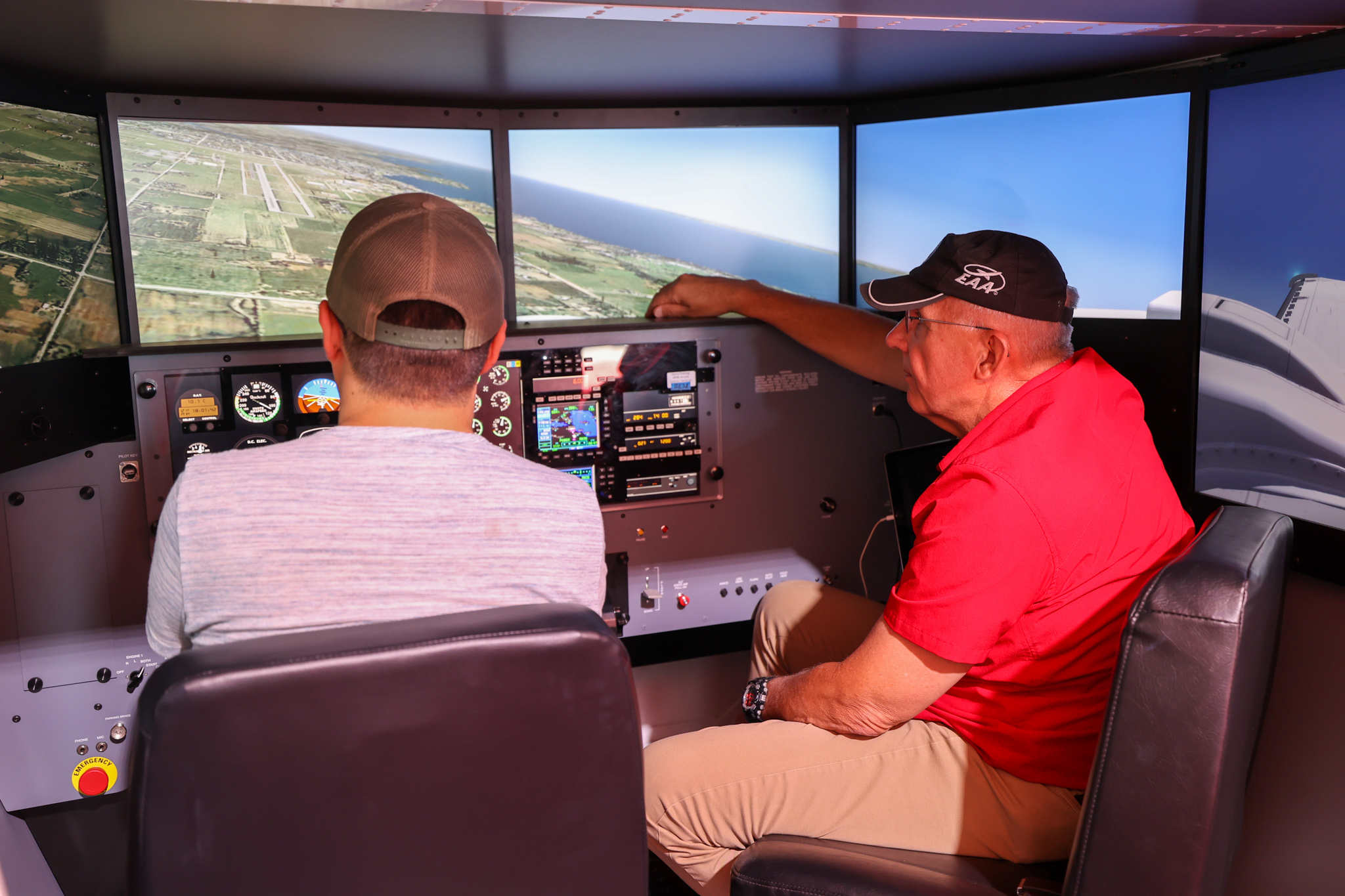
One of the clearest indicators of how a school views its simulator is how it schedules it. When the simulator is booked only when aircraft are unavailable, left out of the primary dispatch system, or treated as optional, it performs exactly like a secondary asset.
Schools that see strong simulator performance tend to make a simple but meaningful shift. They put the simulator on the same scheduling platform as their aircraft, enforce the same cancellation policies, and expect instructors to plan simulator time intentionally rather than opportunistically.
This is not a technology issue. Assets scheduled like first-class equipment tend to perform like it for the owner.
Instruction
Instructor behavior ultimately determines simulator utilization. If instructors believe simulator time is less valuable, harder to sell, or detrimental to their own career progression, they will avoid it regardless of policy statements.
When simulator instruction is compensated fairly, integrated into syllabi, and supported through instructor training, adoption rises quickly. In models where Guided Independent Flight Training is used, instructors are not asked to trade aircraft hours for simulator hours. They remain in the airplane while the simulator absorbs training tasks that do not require their physical presence.
For instructors, loggable hours are preserved. For students, momentum improves. For owners, capacity expands.
Predictable income smooths cash flow, reduces staffing whiplash, and lowers operational stress. In that sense, simulators function not just as training tools, but as risk-management assets.
An idle simulator represents capital without return, missed training opportunities, and possibly unnecessary pressure on the aircraft fleet. Unlike aircraft downtime, which often feels unavoidable, simulator underutilization is almost always the result of policy, pricing, or culture.
The schools that extract the most value from simulators don’t talk about the simulator as something that supports the fleet, but treat it as part of the fleet. That shows up in scheduling, instructor onboarding, training design, and capital planning. It also shows up in the operation’s bottom line in a welcome manner.
Simulators do not replace airplanes. But when viewed through an owner’s lens—cost, utilization, margin, and capacity—they often emerge as the most efficient fleet asset on the field.
Share this
.jpg)
3 Popular Options for Financing a Flight Simulator
Why a Flight-Simulator-First Approach to Training Benefits Everyone