

Pilot and journalist Pilar Wolfsteller recently penned a training tip for AOPA about a flight she almost took. It was a nice day. She'd forgotten her backup radio and decided it didn't matter, and she wasn't especially well rested. Then the glass panel threw a hardware fault that took three power cycles to clear, her headset battery died during taxi, and a canopy warning lit up during the runup. She'd checked the latch herself, so she ignored the warning.
The warning turned red on the takeoff roll. She rejected the takeoff, taxied back, and went for a bike ride instead.
That was the right call, made at the last possible moment with the airplane accelerating down the runway. Every earlier sign showed up while the airplane was parked or rolling at walking speed, which is often where a lot of the most critical judgment calls for any flight happen. Yet the moving airplane is where most of us try to teach judgment.
The Cognitive Limits of Teaching ADM in the Cockpit
The FAA's Pilot's Handbook of Aeronautical Knowledge estimates that about 80 percent of aviation accidents are related to human factors. The same chapter (PHAK Chapter 2, Aeronautical Decision-Making) also says, with less fanfare, that good judgment can be taught. The old assumption was that judgment came only from years of experience (and a few close calls). The handbook rejects that and cites research showing that pilots who received ADM training made fewer in-flight judgment errors than pilots who didn't.
So most CFIs teach it. PAVE, IMSAFE, the 3P model, DECIDE, and the five hazardous attitudes all get their turn on the whiteboard, and learners can usually recite them by the time they solo. However, using one under load is a different skill.
A learner with 15 hours has very little spare attention in the airplane, and taxi, runup, radio calls, and the takeoff itself use up most of it. When the instructor tries to turn a real-world moment into an ADM lesson ("The ATIS just went to gusts of 22. What do you want to do?"), the learner answers with whatever capacity is left, which isn't much. The conversation gets short. Often the instructor ends up making the decision and explaining it afterward, and the learner absorbs the outcome without practicing the process.
It's also expensive. A five-minute discussion in the runup area costs the learner five minutes of Hobbs time, plus the fuel burning while everyone thinks.
The Advantages of Flight Simulators in Decision Training
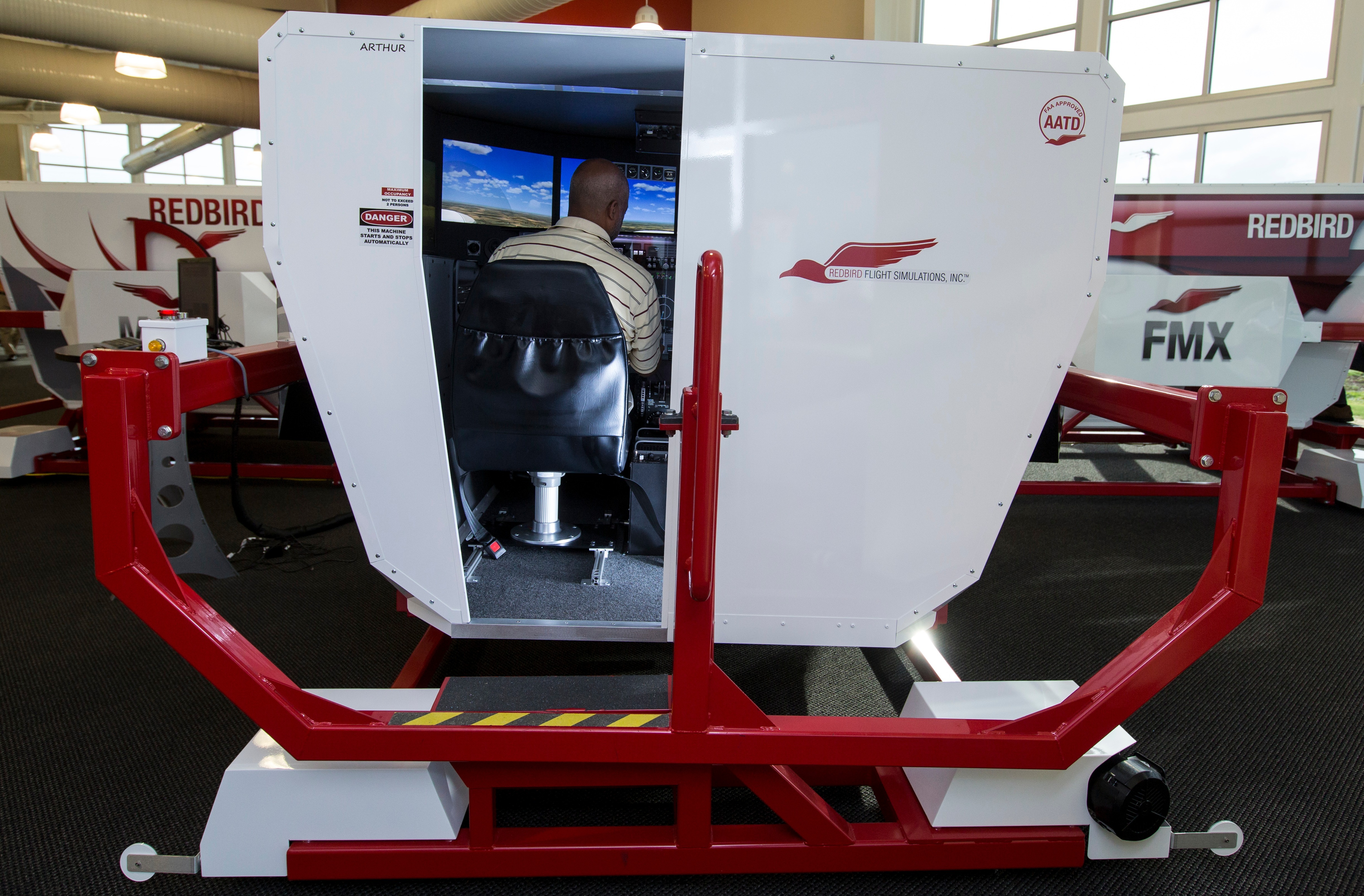
An airplane won't let you control workload. A flight simulator will, especially if the instructor makes strategic use of the pause button.
Freeze the simulation at the moment a decision is needed, and the learner gets as much time as the lesson requires. The instructor can ask what she's seeing, what her options are, and what each one costs, while nothing burns fuel and nobody waits behind her in the runup area.
Redbird's scenario tools let the instructor set the weather, the time of day, and the starting position, and program failures to occur at a set time after the flight loads. Save a scenario just before a decision point, and you can bring a learner back to that exact moment as often as you like, or hand the identical problem to every learner in the program.
Flight simulator training also lets a learner make the bad decision and live with it. If she decides to launch into weather that's trending down, the instructor can keep lowering the ceiling and watch how long it takes her to recognize the trap. That lesson tends to stick, and no responsible instructor would set it up in an airplane at any price.
3 Practical ADM Exercises to Integrate Into Your Flight Syllabus
1. The Accumulating-Signs Scenario (Pre-Flight Go/No-Go)
- Objective: Help learners recognize the compounding danger of multiple minor, non-grounding hazards.
- Setup: Brief a standard local flight, then systematically stack minor stressors: an open squawk in the log, a weather forecast trending marginal.
- The Drill: Pause the scenario after introducing each new item. Prompt the learner: "Are you still launching? Where is your line, and which item tipped it?"
- Debrief Focus: Evaluate the decision-making process rather than the outcome—specifically identifying the exact point where cumulative risk exceeded personal safety margins.
2. The "Freeze, Decide, and Repeat" Drill
- Objective: Practice structured decision frameworks (such as the FAA 3P model) under low, moderate, and saturated cognitive load.
- Setup: Create a sudden decision point during flight—such as an ATIS update, an alternator failure 20 minutes into a cross-country, or an en route weather deterioration.
- The Drill:
- Pass 1 (Frozen): Pause the simulator immediately when the issue arises. Methodically walk through Perceive, Process, and Perform without time pressure. Unpause and execute.
- Pass 2 (Real Time): Reset to the same starting point. Run the identical failure with no pauses.
- Pass 3 (High Load): Run the scenario a third time, adding unexpected secondary stressors (such as an immediate runway change and a rapid frequency handoff) at the critical decision moment.
- Debrief Focus: Compare how decision quality held up across all three runs as distraction and task saturation increased.
3. Dedicated Pre-Solo Decision Sessions
- Objective: Formally assess a student's risk management independence before issuing a solo endorsement.
- Setup: Schedule a one-hour simulator block dedicated entirely to go/no-go and diversion decisions prior to the first solo and solo cross-country flights.
- The Drill: Expose the student to unexpected runway closures, crosswind shifts near solo limitations, and deteriorating ceilings along a route. Allow the learner to execute diversion procedures independently with zero CFI intervention.
- Debrief Focus: Give the instructor concrete, documentable evidence of risk assessment skills to support the endorsement, replacing subjective "gut feeling."
Testing Personal Minimums for Certificated Pilots
Take an instrument-rated pilot with 1,000 hours, 150 of them in actual IMC. He's made plenty of good decisions. He has probably also written personal minimums that have never been tested.
Set a simulated scenario to his minimums for ceiling, visibility, and crosswind component, at night if his minimums cover night, and let him fly the approach. Then lower everything a notch and watch what happens. Plenty of pilots find out their minimums came from wishful thinking, and that the numbers on an index card from three years ago don't match what they can fly today. Finding that out in a simulator costs roughly half of what an hour of airplane rental does at most schools. Finding it out in the airplane can cost a great deal more.
Few flight schools sell this, but it presents an opportunity for incremental revenue. Call it a personal minimums check, price it as a one-hour sim block with a CFI, and market it to certificated pilots before winter weather arrives.
The Bottom Line
The ACS evaluates risk management alongside knowledge and skill, so learners are tested on judgment as well as stick and rudder. A school that can show learners practicing decisions through structured, scenario-based training has a concrete answer when a prospective learner asks how training will prepare her for real flying. The same scenarios turn weather days and maintenance days into billable sessions that still move the learner forward.
Learners also notice when an instructor asks what they think and then gives them time to answer. That can be rare in an airplane, and in a flight simulator, it can happen every lesson.
Share this
How To Renew Your Flight Instructor Certificate With Redbird Pro

When To Say No Go: Mastering the Toughest Decision in Flying